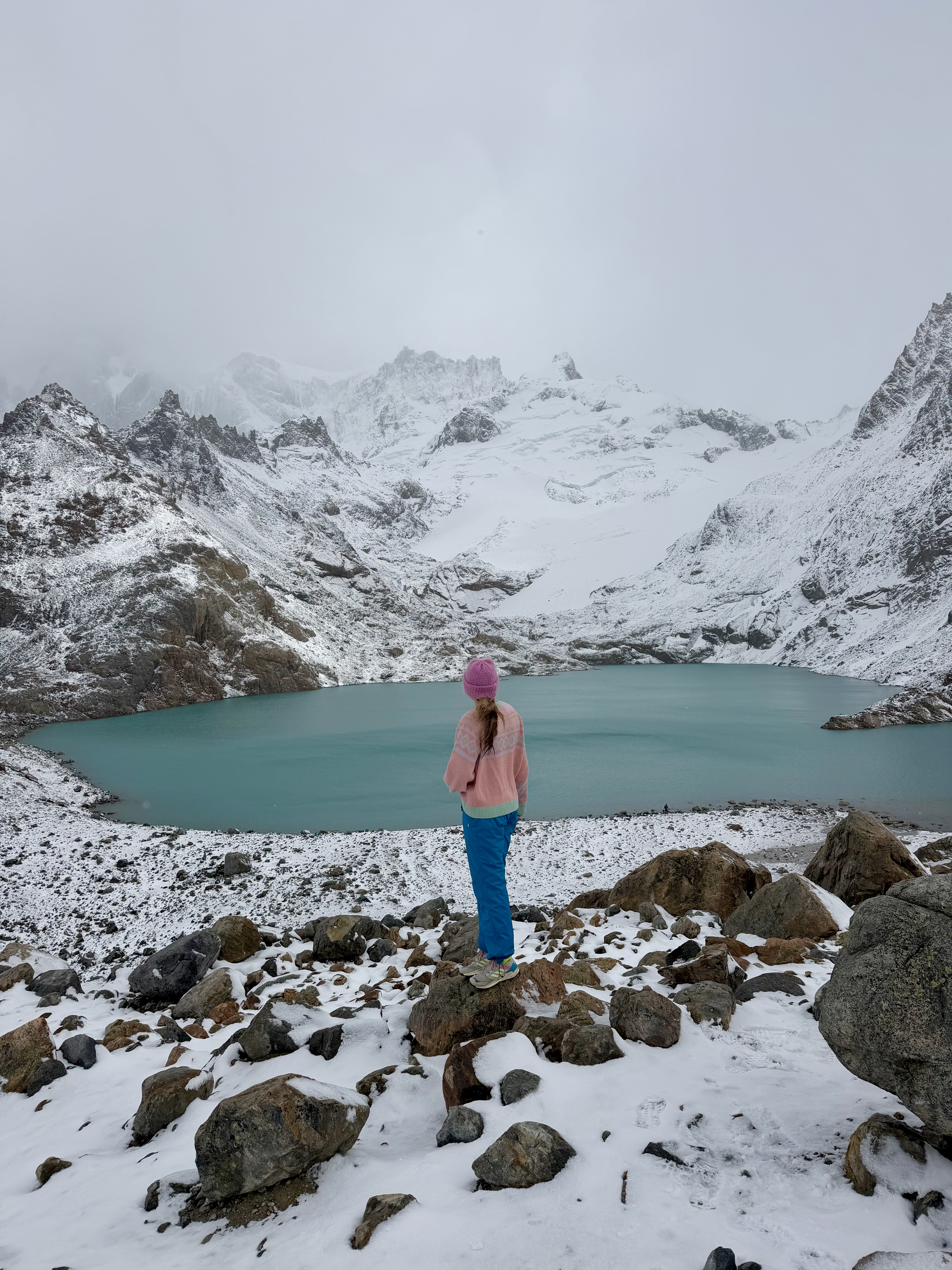
I have been home from Argentinian Patagonia for about 4 days. It is safe to say I think about nothing else. I am already dying to go back. Admittedly, there is still much limited information on the internet about both Chilean & Argentinian Patagonia in my opinion.
So, if you’re planning a trip to Argentinian Patagonia, this guide covers everything I wish I knew before visiting El Calafate and El Chaltén, from transportation and weather to hiking, national park passes, packing, money and what to expect once you’re there.
Main Towns in Argentinian Patagonia: El Calafate & El Chalten
First of all, you may be confused right at the start when you’re reading about two different towns. There are two main towns in this area of the world, El Calafate and El Chalten. I absolutely recommend spending time in each town. Even if you’re not a big hiker, there are things to do and views to see.
El Calafate
This is the jumping off point for a more relaxed version of Patagonia. Here is where you can base to go see the Perito Moreno Glacier. This is the main attraction here and it is about an hours drive from the town.
The actual town here is far bigger than El Chalten. There are more shops, restaurants, cafes, bars, etc. If you’re not in Patagonia for hiking, there is still quite a bit to do in this area. You can horseback ride, take a 4×4 tour, walk the lake, do some light hiking, etc.
If you ARE here for the epic hiking, you’re going to need to head to El Chalten.
If you’re looking for more detailed info about El Calafate, check out my post here —-> El Calafate: the Gateway to Argentinan Patagonia


El Chalten
This is where you’ll find Mount Fitz Roy and the Patagonia logo. This is the main and most epic hike that many people come to this part of the world to do. If you came here to hike, this is the town you should prioritize. This town is smaller and more remote, but it is SO special. It also has MORE than enough to keep you busy between hikes. There are a few breweries, plenty of restaurants, cafes, and small shops.


How to get to Argentinian Patagonia
It is important to note that no matter where you plan to visit you’ll be flying into El Calafate. I do recommend spending at least a night here and checking out the glacier. It is worth the effort. The airport here is very small and easy to navigate. I also actually has a decent lounge if you have access.


When is the best time to visit Argentinian Patagonia?
Only you can answer this question, but in general here are some guidelines.
Mid Nov-Through Feb: Peak season. No matter what time you visit Patagonia you can have any weather. But peak season gives you a little bit of a better shot. It also gives you longer days and longer days give you more chances for activities. It’s also important to remember that no matter how much daylight you have, you still have to account for WIND. Crowds will also be far more intense during this time.
March-Early May: This is fall in Patagonia and is a shoulder season. You may find slightly better pricing and less crowds. It’s also an AMAZING time to see fall foliage. We traveled in late March and the trees were stunning but we had A LOT of rain.
Mid May-August: Off Season: Unless you’re experienced in extreme winter, this is NOT time to visit. Many things close down during this time.
Sept-Late Nov: Another Spring type shoulder seasons where you can try your luck with weather and crowds.
What Language is spoken in Argentinian Patagonia?
Spanish is the primary language spoken in Argentinian Patagonia.
Yes you can get by if you don’t speak any Spanish. It definitely helped a lot that we are semi-conversational in Spanish. If you know nothing at all, you will probably want to use some sort of translation device.
Most printed signage, menus, directions, etc were in Spanish & English. So you can always use them and point.
Please remember to be respectful and polite. You are visiting a Spanish speaking country, so of course they speak Spanish. I get frustrated by the amount of people who just EXPECT people to speak English wherever they go.
How to get around Argentinian Patagonia
Rent a car and drive Patagonia
If you want to have the ultimate freedom on your trip this is absolutely the best way to get around Argentinian Patagonia. This is likely the most expensive mode of transport, but we found it to be SO worth it. The roads to all of the main towns and attractions are paved and very easy to drive and navigate.
You don’t have to wait for groups to do anything or be on anyone else’s timeline. The drive between El Chalten and El Calafate is absolutely GORGEOUS and we got out of the car an insane amount of times to just look at the scenery or check out the guanacos etc. It is very freeing to be able to do this at your own pace.


Tours/Small Groups
A small group tour is another way to get to and from the major attractions. While this will be midrange budget-wise, it still does offer you a bit more freedom. You may be able to select group size, times, and stops a bit more freely.
Buses
The bus is going to be the most restrictive in terms of when you go, however it is also the most affordable option. The buses do run frequently and the bus stops are easy to get to in each town. Personally though, the lack of freedom the buses provide made this our last choice.
Hitch Hiking
This is not particularly an option that I condone or suggest due to the nature of the beast. Although free, you may encounter any number of other issues with this method. However, these towns are EXTREMELY safe and relaxed and most people are there to see the main sites. We did see a number of hitch hikers in the area and it truly didn’t seem to be problematic in any way. So if it’s your thing, this could be the place to go for it.
National Park Passes in Argentinian Patagonia
You must pay to hike in Argentinian Patagonia now. You are able to buy passes for 1, 3, and 7 day periods and you need to have them on you at all times. There are small little huts at the start of each hike that will check for the passes. You can buy them in advance online, which is what we did and made things very easy. They give you a QR code that is super easy to scan and you just show it before each hike.
You can also buy passes on site at the start of many of the hikes. The passes are good for the hikes in El Chalten as well as for the Perito Moreno glacier. So if you’re planning to visit both the passes will cover you. I do not advise you skip this, although some people will tell you that you can get away with it if you start early. Even our Fitz Roy hike (which we started in the pitch dark) they were checking. It’s also not unreasonable to ask people to pay for upkeep of the land etc.
How to navigate while driving in Patagonia
When Driving
When driving, it is very common to lose signal. Therefore it is very valuable to download offline maps. This way you can navigate with no issues whether you have signal or not. The roads to most attractions are VERY clearly marked and honestly it would be hard to mess it up. But navigation makes you feel more secure.
When hiking
Again, there is not much signal when you’re hiking in the mountains of Argentinian Patagonia. I HIGHLY recommend downloading offline maps, like maps.me, as well as AllTrails. Both of these apps helped us so much in making sure we were safe and able to navigate at all times.
Staying connected in Argentinian Patagonia: wifi/LTE/etc
In both El Calafate and El Chalten, we got great LTE signal on our phones. Also all of our accommodation as well as many restaurants, cafes, and bars have wifi.
However, as mentioned above, as soon as we got even a bit off the beaten path this became more difficult. There was no LTE signal on any of our hikes and on the drive we lost signal for a large portion of the trip.
What to do if you don’t have the gear for Patagonia
If you’re looking at packing for this trip and you don’t naturally have a lot of the needed gear, you don’t need to go out and start panic buying. You can actually rent a good amount of the things you’d need in the towns.
I would absolutely make sure to reach out beforehand and check about any major items. We were able to rent headlamps, for example, since we decided to start our Fitz Roy hike in the dark on a whim.
You could also rent a lot of different clothing/gear/navigation devices, etc.


Drinking water in Argentinian patagonia
The hotels we stay at advised that we didn’t drink the water. We didn’t ask questions and followed their recommendations.
What if there is an emergency in Patagonia
This is one thing I wish I’d given a little more thought to before we traveled. Thankfully we did not have a single issue on our trip. But my mind couldn’t help but wonder what in the heck we would have done if we had.
If we were to do a trip like this again, I’d definitely rent some kind of emergency satellite phone that we could use if we had a problem while hiking.
Also if you have any underlying conditions I think it would be important to research medical care in the area. El Chalten particularly did not seem to be well equipped to deal with any health issues that may arise.
Travel Insurance for Patagonia
The above section about emergencies leads right into the idea of having travel insurance. I’ll be honest, we almost NEVER buy travel insurance. I know this isn’t popular advice. But, any time we’re heading into a mountain trip or a trip where anything could happen we buy it. It just makes sense to have the safety net as you never know what could happen.
Cash/Credit Cards in Patagonia
Before we traveled to Argentina we read so much information online saying we’d need cash for everything. We panicked and showed up to Argentina with 2,000 USD cash and exchanged it for Argentinian Pesos right away.
It was super awkward/kinda scary walking around so cash heavy all the time, especially considering we rarely have physical cash even at home. In the end we didn’t encounter one single place that did not accept credit cards.
In fact many places told us we’d get a better rate if we actually use our credit cards. We ended up exchanging a bunch of our Pesos BACK into USD at the end of our trip.
This is not to say you should not bring cash. Things can change at any time and having a safety net is super important. But even in El Chalten, the most remote location of our trip, we were able to use our card at every store, cafe, restaurant, grocery, etc.
Patagonia Weather: Be Prepared for anything
I think if you’re planning Patagonia, you already know you’re going to be in for it with the weather. We’ve visited both Chilean and Argentinian Patagonia now, in both Summer and Fall, respectively, and I can say both times the weather was nothing less than wild. It’s part of the experience.
The best thing you can do is to get to know the weather website windguru. We found this to be the most accurate way to figure out what days were going to look like. This tells you the wind speed, cloud cover, rain levels, and more for each day. It was an app built for wind surfers but actually ended up being very beneficial for hikers.
We used this app daily to plan our hikes and honestly it was as close to accurate as you could hope anything would be.
Just know that in Patagonia you can have rain, snow, hail, bright sunshine, etc. all within MINUTES of one another. You need to be very well prepared.


The food scene in Argentinian Patagonia
It’s hard to know what to expect when visiting remote mountain areas. We went in with realistic expectations. It’s hard sometimes to get good ingredients to these types of places, or to get all the things you need to make a complete meal etc.
We were BLOWN AWAY by the food scene in both towns. We had excellent meals the entire time and both towns had so many options. They each had some pretty surprisingly upscale places, as well as your regular spots and then easy meals at good prices.
Both towns also have grocery stores where you could shop and cook in your accommodation if you’re staying in a spot with a kitchen.
If you’re in a hotel/hostel you also have the option to order lunches for your big hiking days. There are also a ton of cafes in town that serve pack-lunches for hikes as well. The area is centered around hiking so they know how to support you!


What to expect from Hotels in Argentinian Patagonia
Even though we stayed in what were both labeled as 4 star hotels, both of our hotels were pretty bare bones. They were nice and comfortable. But nothing like what I’d expect from a 4 star hotel in the US or Europe. I am not complaining, just want to make the distinction.
Regardless, as far as Patagonia goes, I researched these hotels to death because I wanted to be comfortable after long days of hiking in crazy weather. Both of our hotels fit the bill.
In El Calafate we stayed at Hotel Las Dunas. I loved this hotel for it’s location and absolutely stunning view over Lago Argentina. I will seriously forever dream about the sunrises here. The rooms were HUGE and clean and when you’re hiking having a lot of space to throw your gear around after a long day is wonderful. It was an easy drive to Calafate town and we also did our day trip to the Glacier from here. I loved running on the promenade in front of the hotel in the morning, breakfast was wonderful, and we loved hanging out here in between our adventures.
To check availability and book this hotel —-> Click here
In El Chalten we stayed at Chalten Suites hotel. We had a room with a balcony view of Mount Fitz Roy! The room was very cozy and comfortable and the hotel itself was just what we needed. It was walkable to everything in town and even to many of the hiking trailheads.
If you’re interested in this hotel you can check availability and book —–> here


What to expect from hikes in Argentinian Patagonia
To be honest, we found hiking here to be fairly easy. The two BIG hikes to Mount Fitz Roy (Laguna De Los Tres) and Lago Torre were both less demanding than we anticipated.
While Fitz Roy has a challenging final push, the rest of the hike is quite peaceful through forests, and valleys, etc. The hike to Lago Torre we honestly would have called a long walk.
To be fair, while not very technically difficult these are long hikes. Each one took us around 7-8 hours of our day round trip. This included breaks and hanging around a lot at different beautiful stops. If you’re a slower hiker you can expect an even longer day.


What to Pack for your Argentinian Patagonia Trip
There are so many things to include here and I am going to try my best to cover as much as I can. I have to admit I was SHOCKED at the amount of people who came unprepared to this part of the world.
You need: Merino wool layers (in my opinion they are the most comfortable, quick drying, and so worth the money).
Waterproof pants: seriously do not sleep on this, it is so important to not be wet and you can literally be wet your entire trip. Be prepared. I wear them over regular hiking pants and then adjust as needed.
Waterproof jacket: same as above, I suggest getting a longer jacket to so the run off goes onto the pants and not the waist area.
Gloves: essential
Hiking boots: we wear Adidas terrex hiking sneakers and I LOVE them for comfort and for grip! But some people want a sturdier boot and I get that. Bottom line you NEED grip.
Waterproof socks: nothing has changed my life more than waterproof socks. The level of comfort during a hike is 100% better.
Winter hat: again I prefer merino wool here, but bottom line you want your head to be warm.
Daypack or hiking backpack & COVER: make sure you have a good bag that you’re comfortable with and a COVER for weather. There is nothing worse than everything in your bag getting soaked.
More Patagonia Travel Guides
If you’re super into Patagonia and plan to do Chile along with Argentina, I have some posts here —–> Chile & Chilean Patagonia Posts.
If you have any questions or I missed anything please reach out to me and I’m happy to help. Planformedani@gmail.com or planforme.dani on instagram!